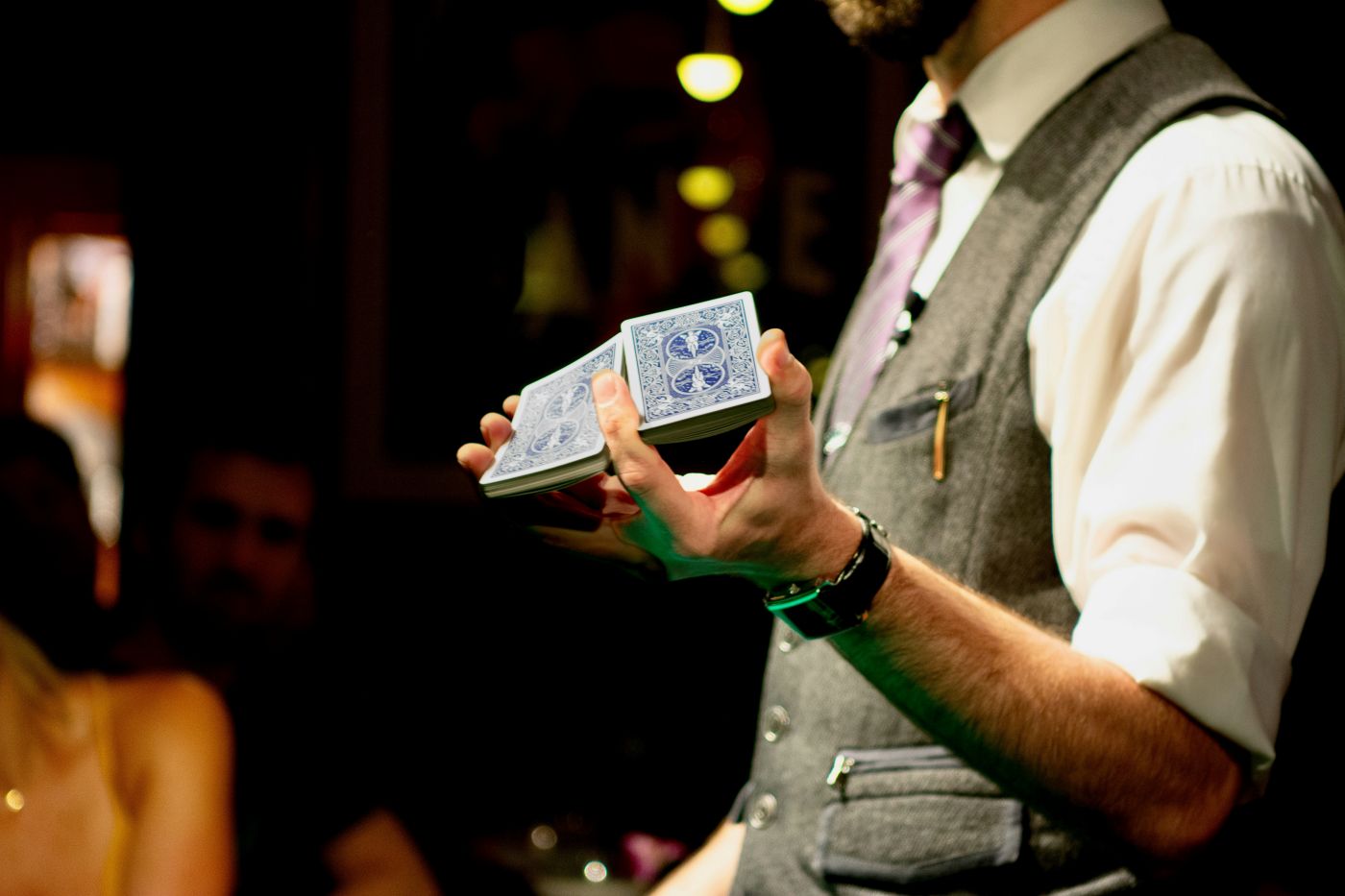
Now, I love a good scam. No kidding, I could watch people on the street fall for the shell game or, even worse, get their money taken from them in a game of three-card monte. I have spent my life with circus performers and some really good close-up magicians, so I know how both these tricks work. I am not nimble of finger, so I cannot do these tricks, but I understand the mechanics. And just that understanding allows me to enjoy these two games without thinking I can win or make some serious money.
Recently I took a trip to Alaska, and it was lovely. The scenery, the small towns, the splendor of nature — just unmatched and stunning. There was also a great deal of history in the journey. Small towns like Skagway and Ketchikan are rife with stories of old prospectors, ghosts, bears, and other hardships that plagued the men and women who went to Alaska to find their fortunes. One of my favorite stories that I learned during my journey was that of Jefferson Randolph “Soapy” Smith. Smith was the kingpin of the Skagway underground for many years, and he got rich pulling a scam that he played not only in Alaska, but also in places like Denver and Creede, Colorado. He also got his nickname, Soapy, because of this scam.
The idea was simple. Smith would open a stand on a busy thoroughfare through the town where he’d sell soap. While setting up for the day, right in front of the crowd, he’d wrap his bars of soap in paper and wrap some of the soap with paper currency, anything from a one-dollar bill to a hundred-dollar bill. Then he sold the soap for between one and five dollars. The scam was easy; Smith had a coterie of “helpers” who made a show of buying the soap and, with a little sleight of hand, Smith made sure his helpers were the ones who got the bars of soap with actual money in them. When the gathered crowd saw these people pull bills out of the wrapped soap, well, the desire to buy grew and soon Smith was sold out. He made a killing and used this trick for many, many years, especially during the Klondike Gold Rush in 1897.
If you go to Skagway now, and I suggest you do, you’ll see a stage show that’s been running for about twenty years. It’s a singing, dancing, energetic show with four performers — among them a saloon piano player and Smith himself — talking about his scams and his empire of criminal conduct in Skagway and Colorado. The show is fun, old-timey, and the performers, who are college kids, do a great job. I sat there rapt in the story and the songs, and I wondered about this Smith guy and how he was able to scam so many people with what to me seemed like an obvious routine. But he did, got a great nickname, and was a mob boss long before we allowed Tony Soprano into our living rooms.
Now, I love a good scam. No kidding, I could watch people on the street fall for the shell game or, even worse, get their money taken from them in a game of three-card monte. I have spent my life with circus performers and some really good close-up magicians, so I know how both these tricks work. I am not nimble of finger, so I cannot do these tricks, but I understand the mechanics. And just that understanding allows me to enjoy these two games without thinking I can win or make some serious money. Oftentimes, even though I know how the trick works, I am stunned by how smooth and precise some of these street hustlers are in their play. Now, both the shell game and the three-card monte started as entertainment, part of many stage magic shows, delighting audiences as the pea seemed to jump from shell to shell or the red queen appeared to have a mind of its own. In a theater, seeing a prestidigitator perform, no one is losing their rent money, and so, the street scam is now entertainment.
Many famous magicians, like the late great Ricky Jay, use the cups and balls as part of their act, and Jay was quite gifted with the trick. When I returned from Alaska, I happened upon a video of Ricky Jay and His 52 Assistants, a stage show that ran off-Broadway in NYC in 1994. As I watched the section where he gives a history lesson while perfectly performing the cups and balls, I thought of Ol’ Soapy Smith and the years I had spent on the streets of NYC, Boston, Rome, London, and other tourist spots, watching men (usually I’ve only seen men doing this) take tourist cash doing the cups and balls or the three-card monte. What, I wondered, is the difference between a scam and an entertainment? In branding and marketing, how close to the line do we get? Are we entertaining, selling, or scamming the masses?
A Scam vs. a Trick
For the cynical, a scam and a trick are the same. Both, according to this view, are lying and using dishonest methods to make people believe in something that isn’t real. Christianity is full of stories of banning magic and books on the subject. These early Christians and, believe it or don’t, some modern sects still believe that magic is “of the devil” and that making supernatural things occur without the aid of God is forbidden.
In Judaism, the Hebrew Bible strictly prohibits sorcerers, magicians, wizards, and necromancers. These laws are specifically laid out in Leviticus and Deuteronomy. Here again, the laws say no magic because it works against the sublime divinity of God, the only one who can make miracles happen.
Now, those on the religious side are against magic because they find it offensive to God. Modern-day street magicians, the ones who run a three-card monte or a shell game, are looked on with a litigious eye because they are offensive to the almighty dollar. And that’s the difference. A trick is something we see in a theater or performed by a legitimate magician or busker. They trick you, but you understand that there is consent. You bought the ticket, you’re taking the ride, you are going to see an evening of magic and, apart from the entrance fee, no one is going to trick you out of your money or your belongings. You’ve willingly walked into the theater knowing you’re going to see things that will blow your mind, but not your budget.
On the other hand, a scam is always rooted in personal or financial theft. Whereas a trick is pure entertainment, a scam sees you being tricked into giving your money or valuable things away unwillingly. The only difference between the three-card monte you see being run on any major street in a bustling city, and the one you see from the third row of a nice theater is the venue. The trick is performed exactly the same in both places; the difference is consent. Do I willingly give up my money — admission to the venue or show — or is it taken from me, as in the scam on the street? It’s a very fine line, but one that could cost you some serious money and emotional upheaval if you’re not careful.

The Law Steps In
Here’s where things get a little dicey. When we brand and market, how close to the line are we getting? Well, if you look at the history of it, before 1914 and the advent of the Federal Trade Commission, which was formed to actively regulate deception in ads, the world was crazy. Any claim, any omission, any “results” were on the table for advertising. If you had a product, you could claim it would cure cancer, and that would be fine. Miracle medical products, hyperbolic language used to confuse and bolster sales, and even mystery ingredients, like alcohol, morphine, and cocaine, were all permitted until the Pure Food & Drug Act came about in 1906. In 1911, the Truth-in-Advertising Codes were adopted, eventually leading to the formation of the FTC, and the things we bought started being regulated for our safety.
Before the FTC, it was all a bunch of scams, and people shelled out good money for bottles of snake oil. So the claims of miracle cures and overnight perfect health got the eyes of the law on them, and over-the-counter scams dissipated. But they never went fully away, and even after the formation of the FTC, marketing agencies found an easy way around the whole “truth.”
Some of the ways advertisers got around the rules were fake lab reports and fake science. They would put laboratory proof on the label, and people believed that science had a hand in the products. Of course, there was no lab and no proof, but that didn’t stop marketers from saying the words lab and proof in the same sentence.
Copywriters were being employed to find tricky ways of making claims without making claims that could be proven or disproved. These word wizards would fill squares in the backs of magazines with sly words that skirted the edge of being provable as lies, and the products would sell.
All of it came to a crashing end in 1938 with the introduction of the Wheeler-Lea Act, which gave the FTC power to stop products with false advertising that tricked consumers, not just unfair business competition. Now the shell game had Big Brother watching, and no one would say anything false or misleading about a product ever again. If you believe this, please proceed directly to the end of this piece and fill out the form for your chance to buy the Brooklyn Bridge at a reasonable fee.
Amazing
Advertisers are still doing what they can to slip words and ideas into their marketing to help their product stand out. Always skirting the edges of what’s allowed. Then, in 1975, an advertising exec did something incredible that made him a millionaire almost overnight, and he did it without lying or trickery; he simply told the truth.
That year, after talking to some friends about how high-maintenance pets were, Gary Dahl gave the world the Pet Rock. It came in a small cardboard box with vent holes cut in it, some cut-up hay, and a how-to booklet. So simple and yet so brilliant.
The manual said that each rock had come pre-trained to follow some basic instructions: how to sit and how to stay. With its box, bed of hay, and air holes, this idea caught on like wildfire, and during the height of the craze, Dahl sold over 1.5 million Pet Rocks. It was estimated he paid about a penny for each smooth stone, and he sold them for $3.95. All told, Gary grossed about six million bucks when all was said and done.
Was this a scam? Nope. He said it was a pet rock: no upselling, just a pet that was super low maintenance, that would always listen and be your best friend. The owner’s manual, with its tricks like stay, sit, be silent, etc., was hilarious and still not a scam. Never at any time did Dahl claim the package contained anything more than a rock, something you could find in your own garden or on the street — just a rock in a box, and a phenomenon was born.
No one was scammed. The box said what the contents were, and no one felt cheated. But, in some ways, it was a scam, wasn’t it? Anyone could walk out on the street or on a beach and pick up a stone and call it a pet rock. Anyone could have done it. However, Gary Dahl did it, and he made a fortune from it. Scam or entertainment?
Where Do We Go From Here?
Here’s what stuck with me after Skagway. Soapy Smith didn’t get rich because his scam was clever. He got rich because he understood that people will believe a demonstration over a claim. He never once said this soap contains money. He let a stranger in the crowd say it for him, and then he let the crowd say it to each other.
That mechanic never went away. It just got a media plan. The bar of soap with the hundred-dollar bill in it is the before-and-after photo, the creator who “found this thing and had to share it,” the review section stocked in advance, the badge that says clinically studied without naming the study. Nobody makes a claim. Somebody just gets to be seen pulling money out of the soap. The FTC has rules about most of this now, and the rules mostly work, and the work-arounds are as old as the Printers’ Ink codes — because the incentive to imply what you can’t prove is permanent.
So when I ask how close to the line we get in branding and marketing, I don’t think the honest answer is a legal one. Compliance is the floor. Legal is not the same as earned. The real test is the one Ricky Jay passes and the street monte dealer fails, and it isn’t skill — the monte dealer is often the better technician. It’s consent. Jay tells you he’s going to fool you. Knowing doesn’t ruin it; knowing is the whole pleasure. The tourist on Canal Street was never told, and that’s not a technicality, that’s the entire crime.
Which brings me back to Gary Dahl, who I think is the most underrated marketer of the twentieth century. He had a rock. He wrote a box that said rock. Every buyer knew exactly what they were purchasing and bought it anyway — 1.5 million times — because Dahl understood he wasn’t selling a stone, he was selling the joke, and the joke only works if you’re in on it. He made his fortune by refusing to hide the trick. That’s not a loophole. That’s the best-case version of this business.
The line is not between clever and plain. It’s between an audience that’s in on it and an audience that finds out later. Every piece of marketing you make sits on one side of that line, and your customer will eventually work out which one.
The Takeaway
A trick and a scam use identical mechanics. The only difference is whether the person in front of you agreed to be fooled.
Marketing lives on that line every day, and the pressure is always in the same direction: imply more than you can prove, let someone else make the claim you can’t. It’s effective. It’s also a loan against a customer who will eventually read the box.
Say what’s in the box. Then make the box worth opening.