
Your brand has words. These words show up in style guides, urban guides, website copy, emails, and all other materials that are connected with your brand. If you’re smart, you’ve hired a copywriter, a pro who makes their bones on understanding words and putting them in an order that will sell your product, highlight your service, or just turn people on to your message.
I’m not a very physical guy; let’s face it, I break into a sweat when someone asks me to pass the salt. My boss just ran an Ironman competition, which made me think, “Hey, I can do that,” until I found out it has nothing to do with shirts and pants, a hot iron, and a board. His Ironman adventure included swimming, biking, and running, and again, I started to sweat and needed to sit down when I heard what he was doing. The point is, if this ship is going down and it’s up to me to climb up a wall and plug a hole, well, my friends, say your prayers, because this isn’t going to end well.
I recall that when I was a kid, I walked into our kitchen, very upset because someone at school had called me fatso. My mother, ever the angel of kindness, said to me, “Sticks and stones may break my bones, but names will never hurt me.” Then she kissed my forehead and gave me a glass of milk and a plate of cookies. Then Pa came home, and we all had a nice family dinner, and I grew up normal and happy. The end. Thanks for reading.
Actually, what really happened was that I was sad some kid called me fatso, I told my mother; she said, “suck it up,” as she stubbed out a cigarette, pulled another from the pack, matched it, and blew a cloud of smoke toward me. My father came in, asked what was going on, and he echoed her parental advice, “Oh, well, your mother’s right, suck it up.” He popped open a beer and sat down to read the paper, and thus endeth the life lesson for that day. And I grew up afraid, shy, terrified, and wounded by names like they were sticks and stones.
Childhood, for me and for many, was just a smorgasbord of pain, humiliation, and praying to get through the day unscathed. Most days I failed, some days I passed, and those days, when no one pointed out my weight, stupid haircut, ugly face, or the fact that I smelled like hot dogs, were like little vacations for my soul. I treasured the days when I wasn’t mocked; they meant everything to me.
It’s hard to explain in a world that says sticks and stones, but a saying like that is coined by people who actually don’t worry or even think about stepping outside their door and bracing for a chorus of rude names and cutting remarks. “If this one doesn’t like me, another one will,” is a great philosophy brought to us by the people who’ve never spent most of math class trying to extract their underwear from deep within their anus because, before class, they were the victim of yet another atomic wedgie.
There is a casual cruelty that kids deliver that some people never face, and so they don’t understand. A kid can easily walk by, drop an insult, ugly name, or racial slur, and move on with their day, never thinking about the kind of devastation they have wrought in the life of someone who’s just trying to make it through the day. Sticks and stones may very well break our bones, but names will send us into therapy for the rest of our lives. Why? Because as much as someone says, “…but names will never hurt me,” that someone doesn’t understand that a kid picking up a rock and hurling it at your head hurts, causes blood, maybe even a scar, but that will heal. Having a kid stand up in the crowded cafeteria, trip you so you fall and spill your lunch tray all over the floor, and then yell, eat it up, piggy, while the entire room looks at you, laughs, and thanks whatever God they pray to, it’s not them on the floor, at the center of the mockery. Names do hurt, and those scars do not heal as quickly or as easily as a bonk on the head.
I won’t get into the details of the effort I’ve tried to ease my childmind and deal with my childhood; this is a blog, not a medical case study. Suffice to say, yes, sticks and stones may break my bones, but let me tell you, names can do some serious long-term damage as well.
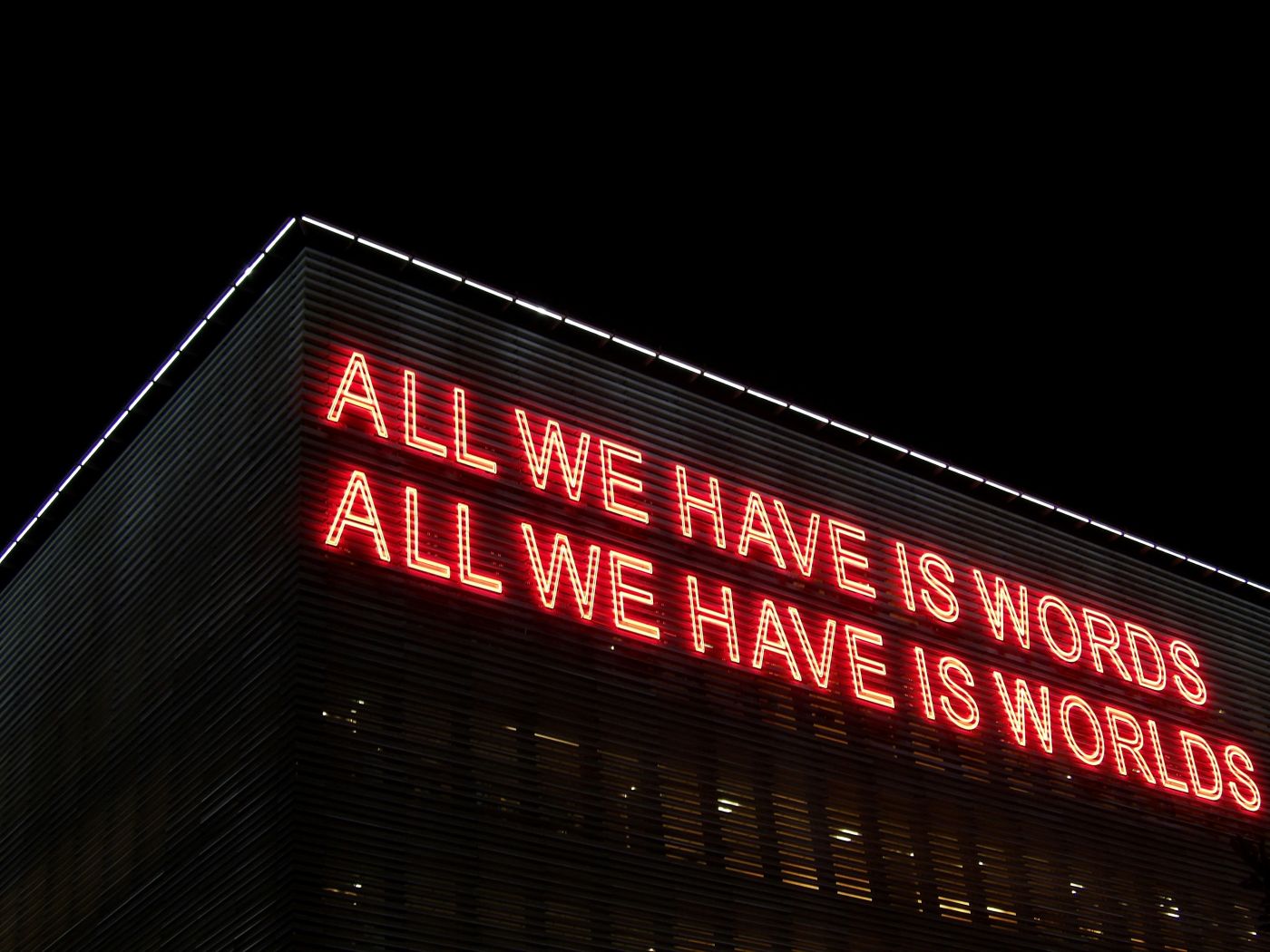
WORDS
The Gin Blossoms once sang:
“Turn summer trees to bones and ice,
Turn insect songs against the night,
With words we build and words we break,
I’m drunk, drunk, drunk in the gardens and the graves.”
The words that broke me are also the words that sent me to the bottle and on a course of being drunk, drunk, drunk in the gardens and the graves.
I’m ten years sober now; however, I still cringe at words. In movies, when someone is calling someone else fat or stupid, I sink into my seat. I hear sticks and stones in my head, but in my heart I hear “Hey, fat!” Now, before I go too far and have people who read this charge me for a therapy session, I should make my point, and it’s this: words, no matter how they are woven, packaged, and delivered, mean something. Words mean things, and they have a deep impact, often deeper than most people believe or understand.
My best friend says to me all the time, stop saying bad things about yourself. The way I do at the top of this, the way I make myself the butt of every joke, and the way I’m so quick to tear myself down. For me, it’s deep and has something to do with self-hatred and a childhood of being the center of humiliation. I’ve grown up thinking, I better say it before someone else does, because someone will.
For me, it’s self-preservation, but that doesn’t mean it’s all right or even slightly healthy. I need to stop, but sadly my insurance doesn’t cover endless therapy or electroshock sessions, so on I plod with a mind full of names and brutal words. Those words, mine and the pastiche of words that have filled my personal lexicon over the decades, mean something and they matter. They do matter, and saying they don’t hurt or matter doesn’t help. That lie permeates every part of our lives, and we wonder, “Why does this hurt me? No one else seems to be getting hurt; am I just weak?” No, I’m not weak; you’re not weak. The reality is words matter.
Your Brand Words
Your brand has words. These words show up in style guides, urban guides, website copy, emails, and all other materials that are connected with your brand. If you’re smart, you’ve hired a copywriter, a pro who makes their bones on understanding words and putting them in an order that will sell your product, highlight your service, or just turn people on to your message. That copywriter brings knowledge, training, and a healthy scoop of life experience that allows them to dig deep and fearlessly bring your copy from just words on a page to words to live by.
One of the problems right now is that folks are looking at AI and thinking, oh great, I can plug a few prompts into this and then, bing, bang, boom, I have brand copy. Tah-dah! But your AI agent will never lift your words off the page and into the hearts of your clients because AI lacks experience. And that lack of experience means they also lack empathy, and empathy under words is what makes them fly and how they find connection in the world. Empathy, experience, heart, and soul those are the things that turn mouth sounds that grab attention for a moment into manifestos, brand promises, and connection, a connection that lasts beyond one knee-jerk laugh or awww at cuteness.
If you’re just throwing words into the design or the guide, you’re doing what the high school bully does, just yelling into the void and hoping the “funny” moniker you just anointed some poor kid with will get a laugh and some attention. If you’re disrespecting the words you choose to have connected with your brand, you’re just a brand bully, and someday, no one is going to listen any longer.
Thinking on Words
There’s a running joke on film sets: someone makes a mistake, glaring, causing another take, and someone will inevitably say, we don’t need another take; we’ll just fix it in post. Or the more truncated version: the director calls cut, and a voice says, “fix it in post.” Everyone laughs, and we go back to one.
If you look at the copy you use for your brand like that- just fix it in post- you’re missing the point, and you’re not using the full power of words.
We’ve established that words have deep impact and they can hurt. But they can also heal, uplift, bolster, and save. Words have such incredible power, and that power really shouldn’t be assigned at the end of the project to the CFO’s cousin, who is planning to go to school to be a writer. The words that you drape your brand in, that you infuse your campaigns with, carry more weight and have greater impact than you’re giving them credit for. Trust me, when you least expect it, something someone said to you or a name someone called you decades ago will suddenly rear its ugly head. Imagine if you could have that effect on a client. Not making them regurgitate an old painful memory, but having them carry the words you use to describe your brand around and repeat them to their friends and family, or even total strangers. That can happen, but only if you give the words the weight and importance they carry.
If you’re not thinking about words as you build your brand, your campaigns will be unintentionally mute. Silence is good and can be very powerful when you choose to use it. But silence that is unintentional sits like a wet wad of paper in your pants. Everyone sees something is wrong, and you’re uncomfortable as hell, but you can’t reach into your pants and haul it out. H.R. frowns on that type of thing, and if they don’t, dear Lord, they should.
The point is, we’ve sold a bill of goods that just aren’t true. Sticks and stones will break your bones and names will bruise your psyche. Words don’t just fill the air and disappear like cigarette smoke; they linger, they stain, the ugly up the place. Take a look at any before-and-after images of an apartment of a non-smoker and one of a smoker. The smoke has dissipated; it’s gone, but the white walls are tobacco-stained, and the chances of getting your security deposit back are nil.
If you’re approaching your copy with a sticks-and-stones mindset, you’re leaving your strength at the door and walking in empty-handed. Words matter. With words we build and words we break. But also with words we elevate and inform, entice and elate, and with the right words, we convert. Because words matter and they have power.
The Takeaway
Words aren’t neutral. They’re not just filler you throw into a template between the logo and the call to action. They’re a liability, the same way a bad wedgie in seventh grade is a liability, one that doesn’t show up right away, doesn’t show up in the room, but shows up later, in ways you don’t expect and can’t always trace back to the source.
Your brand’s copy is either an asset or a liability, and there’s no third option where it’s just “words.” If it’s careless, if it’s cheap, if it’s something you plugged into a prompt box and called done, it’s a liability sitting on your balance sheet whether you’ve noticed it yet or not. It shows up as a client who can’t say why they don’t trust you; they just don’t. It shows up as a review that says “something felt off” and nothing more specific than that, because the person writing it doesn’t have the language for what your copy did to them, only that it did something. It shows up the way names do, quietly, years later, at the worst possible time.
I know what a careless word costs a person, because I’ve been paying that bill my whole life. Your brand can pay it too. The difference is, you get to choose not to.
Words matter. With words we build, and with words we break. Choose which one your brand is doing, because it’s already doing one of them.